(Note: Be sure to click on the footnote links to understand the relevance of this story. They’re the tiny blue numbers that are easy to miss.)
Every morning on my way to work I walk through a small city park, and there I spot him. He’s a scruffy looking middle-aged man sleeping on the bare ground dressed in dirty urine-soaked rags, with a pile of feces lying a short distance behind him. Sometimes he has the remains of a small campfire in front of him, the fuel for which seems to have come from that same pile.

In the evening, on my way home from work I see him there still. Awake now, but still lying on his same side on the ground1. He is often engaged in what appears to be child-like play: enacting wartime battles on a miniature scale with makeshift fortifications from his frying pan and an old fragment of wall tile2.
I have tried to bring him food in the past. He has always refused it, saying that he is only allowed to eat barley cakes baked by himself in a hole dug under his feces-fueled campfire3.
One day, after another failed attempt to induce him to accept a handout, I got to talking with him — but only for a short time because the stench was nearly unbearable. It turns out his name is Ezekiel. The enactments, he says, are prophecies he has received from his god whom he once saw flying through the air in a fiery chariot.

Why don’t they provide housing for these mentally ill ones instead of leaving them homeless?
Another time I saw him with a knife! Who in their right mind would’ve given him a sharp instrument I can’t imagine. He smiled when he saw me and motioned me to come nearer. When I did [being careful to stay out of arm’s reach] he demonstrated a new “prophecy”. He took the knife and cut off a clump of hair from his head. Then he carefully divided it into three equal piles. One of these piles he threw into the fire.

Another was thrown into the wind. The final third he attacked with the knife, chopping it into little bits4.
“What does it mean?” I asked him as gently as I could.
“A fire come forth into all the house,” he said. “The fathers shall eat the sons in the midst of thee, and the sons shall eat their fathers, and scatter thee into the winds.5”
“Who tells you such wicked things?” I ventured to ask.
“Yahweh, our God,” he replied with a sigh.
“Do you have any family?” I asked, “Anyone who could take care of you?”
“Son of man, behold, I take away from thee the desire of thine eyes with a stroke: yet neither shalt thou mourn nor weep, neither shall thy tears run down,” he related, wiping away a tear, then shouting at himself: “Forbear to cry, make no mourning for the dead, bind the tire of thine head upon thee, and put on thy shoes upon thy feet, and cover not thy lips, and eat not the bread of men.
So I spake unto the people in the morning: and at even my wife died; and I did in the morning as I was commanded.” (Ez. 24:16-18)
“So, you’re saying that Yahweh killed your wife and told you not to mourn for her?”
He only nodded; too choked up to speak.
 Just then another homeless person walked past us through the park.
He was stark naked6.
Ezekiel looked at him sternly and shouted: “Isaiah, get the hell off my turf! I’m the prophet in this park.”
“Whatcha gonna do about it, big boy?” Isaiah taunted: “You can’t get up off your side for over a year.”
“I’ve only got 300 days left, naked ass!” Ezekiel vehemently cried: “A third as long as you’ll be dangling your tallywhacker all over town. Go peddle your false prophecies somewhere else.”
Instead, Isaiah curled up on a nearby park bench and fell asleep instantly.
“Naked fool!” Ezekiel cried, spitting in his direction; “giving us real prophets a bad name.”
“Why do you say that?” I asked.
“Don’t you know about that one?” Ezekiel confided, ” He totally botched up a prophecy he had from Yahweh. He was supposed to tell Ahaz, the king of Judah that the attack against him by Syria, Ephraim and Remaliah would fail. Simple enough, right? But he was also supposed to give a sign that a virgin would give birth to a child named Immanuel. And before Immanuel was old enough to say “Mommy” the enemy kings would be captured by the Assyrians7.
 “So what does Isaiah do? Does he ‘wait on Yahweh’? No! He goes and screws the prophetess so she’s no longer a virgin. Then when she bares him a son he forgets and calls him Maher-shalal-hash-baz instead of Immanuel8!
“Yahweh was so pissed that he countermanded the whole prophecy and let the enemy kings kill Ahaz and 120,000 of his men in one day9!
“Oh jeez, here comes another one,” Ezekiel said.
 I looked behind me to see a shabbily dressed man who bore an oxen’s yoke upon his shoulders. In his hand was a cup which, as he approached he offered to me. “Drink some wine,” he said.
I pretended; the cup was filthy, and of course empty. 
“Everyone must drink, and cursed be he that keepeth back his sword from blood,” he said, walking off as if in a trance. (Jer. 48:10)
Ezekiel pointed to his temple and winked: the universal sign to indicate that someone else is off their rocker. “That’s Jeremiah,” he said, “he’s been telling everyone in the world to drink from that cup for years and years10.
“The yoke he wears is supposed to mean that all nations of the Earth will soon serve Babylon. Right; like that’s really gonna happen11.
“Once Jeremiah made a complete fool of himself by ‘prophesying’ to Zedekiah, the king of Judah that he would serve the king of Babylon–and Zedekiah was already serving him at the time! In fact the king’s name wasn’t even Zedekiah until the king of Babylon changed it for him from Mattaniah12. Another “major” prophet — my ass! Which reminds me: I have to take another dump and make some more barley cakes.”
“Okay,” I said, “You don’t need an audience for that. Just give me the knife so you don’t cut any more hair — or fellow prophets — with it.”
“Fellow prophets!?” He screamed, throwing the knife at me. I caught it and made my retreat as he continued his rant.
Epilogue
I haven’t seen any of these “major prophets” in many years now. One day the town decided to clean up the park, and afterwards they were gone. I heard that someone gathered their sayings and bizarre doings into a book, though I don’t know why anyone would bother to read it unless maybe they’re in the mental health field.
— Footnotes —
1Lie thou also upon thy left side, and lay the iniquity of the house of Israel upon it: according to the number of the days that thou shalt lie upon it thou shalt bear their iniquity.
For I have laid upon thee the years of their iniquity, according to the number of the days, three hundred and ninety days: so shalt thou bear the iniquity of the house of Israel. (Ezek. 4:4-5) return
2Thou also, son of man, take thee a tile, and lay it before thee, and portray upon it the city, even Jerusalem:
And lay siege against it, and build a fort against it, and cast a mount against it; set the camp also against it, and set battering rams against it round about.
Moreover take thou unto thee an iron pan, and set it for a wall of iron between thee and the city: and set thy face against it, and it shall be besieged, and thou shalt lay siege against it. This shall be a sign to the house of Israel. (Ezek. 4:1-3) return
3And thou shalt eat it as barley cakes, and thou shalt bake it with dung that cometh out of man, in their sight. (Ezek. 4:12)
According to “the LORD”, the whole point of this filthy exercise was to demonstrate how the Israelites would eat “defiled bread amongst the Gentiles, wither I will drive them.” But Ezekiel was already amongst the captive Israelites in Gentile land (Ezek. 1:1). So, was Ezekiel just demonstrating what was already happening? If so, how was this a “prophecy”? return
4And thou, son of man, take thee a sharp knife, take thee a barber’s razor, and cause it to pass upon thine head and upon thy beard: then take thee balances to weight, and divide the hair.
Thou shalt burn with fire a third part in the midst of the city, when the days of the siege are fulfilled: and thou shalt take a third part, and smite about it with a knife: and a third part thou shalt scatter in the wind; and I will draw out a sword after them.
Thou shalt also take thereof a few in number, and bind them in thy skirts.
Then take of them again, and cast them into the midst of the fire, and burn them in the fire; for thereof shall a fire come forth into all the house of Israel. (Ezek. 5:1-4) return
5Therefore the fathers shall eat the sons in the midst of thee, and the sons shall eat their fathers; and I will execute judgments in thee, and the whole remnant of thee will I scatter into all the winds. (Ezek. 5:10) return
6At the same time spake the LORD by Isaiah the son of Amoz, saying, Go and loose the sackcloth from off thy loins, and put off thy shoe from thy foot. And he did so, walking naked and barefoot.
And the LORD said, Like as my servant Isaiah hath walked naked and barefoot three years for a sign and wonder upon Egypt and upon Ethiopia; (Isa. 20:2-3) return
7Because Syria, Ephraim, and the son of Remaliah, have taken evil counsel against thee, saying,
Let us go up against Judah, and vex it, and let us make a breach therein for us, and set a king in the midst of it, even the son of Tabeal:
Thus saith the Lord GOD, It shall not stand, neither shall it come to pass.
Therefore the Lord himself shall give you a sign; Behold, a virgin shall conceive, and bear a son, and shall call his name Immanuel.
Butter and honey shall he eat, that he may know to refuse the evil, and choose the good.
For before the child shall know to refuse the evil, and choose the good, the land that thou abhorrest shall be forsaken of both her kings.
For before the child shall have knowledge to cry, My father, and my mother, the riches of Damascus and the spoil of Samaria shall be taken away before the king of Assyria. (Isa 7:5-7,14-16; 18:4) return
8And I went unto the prophetess; and she conceived, and bare a son. Then said the LORD to me, Call his name Maher-shalal-hash-baz. (Isa. 8:3) return
9Ahaz was twenty years old when he began to reign, and he reigned sixteen years in Jerusalem: but he did not that which was right in the sight of the LORD, like David his father:
Wherefore the LORD his God delivered him into the hand of the king of Syria; and they smote him, and carried away a great multitude of them captives, and brought them to Damascus. And he was also delivered into the hand of the king of Israel, who smote him with a great slaughter.
For Pekah the son of Remaliah slew in Judah an hundred and twenty thousand in one day, which were all valiant men; because they had forsaken the LORD God of their fathers.
And Zichri, a mighty man of Ephraim, slew Maaseiah the king’s son, and Azrikam the governor of the house, and Elkanah that was next to the king.
And the children of Israel carried away captive of their brethren two hundred thousand, women, sons, and daughters, and took also away much spoil from them, and brought the spoil to Samaria. (2Chron. 28:1,5-8) return
10For thus saith the LORD God of Israel unto me; Take the wine cup of this fury at my hand, and cause all the nations, to whom I send thee, to drink it.
And they shall drink, and be moved, and be mad, because of the sword that I will send among them.
Then took I the cup at the LORD’s hand, and made all the nations to drink, unto whom the LORD had sent me: (Jer. 25:15-17) return
11Thus saith the LORD to me; Make thee bonds and yokes, and put them upon thy neck, (Jer. 27:2) return
12I spake also to Zedekiah king of Judah according to all these words, saying, Bring your necks under the yoke of the king of Babylon, and serve him and his people, and live.
Why will ye die, thou and thy people, by the sword, by the famine, and by the pestilence, as the LORD hath spoken against the nation that will not serve the king of Babylon?
Therefore hearken not unto the words of the prophets that speak unto you, saying, Ye shall not serve the king of Babylon: for they prophesy a lie unto you.
And he carried away Jehoiachin to Babylon, and the king’s mother, and the king’s wives, and his officers, and the mighty of the land, those carried he into captivity from Jerusalem to Babylon.
And all the men of might, even seven thousand, and craftsmen and smiths a thousand, all that were strong and apt for war, even them the king of Babylon brought captive to Babylon.
And the king of Babylon made Mattaniah his father’s brother king in his stead, and changed his name to Zedekiah. (Jer. 27:12-14; 2Kgs. 24:15-17) return



 In Multiplicity, an overworked man (Doug) clones himself. The clone (dubbed “Two”) turns out to be an exact replica adult (!) Two has all the memories of Doug, and initially mistakes Doug for the clone. Naturally; he thinks he’s Doug. However, there is no doubt in Doug’s mind that Two is not him.
 In Blade Runner, an android is given the memories of a young woman. The android believes the memories are of her own past and does not know that she is an android. However, the woman whose memories were implanted in the android knows that the android is not her.
 The Watchtower holds that there is no immaterial, immortal “soul” that is the “real you”. No; the word “soul” refers to a physical human body which has God’s impersonal “life force” animating it. They also hold that God creates a new body for resurrected ones.
 Okay, but what does God “put into” this perfect new body to make it you? Remember: there is no immaterial “soul” such as most other Christian religions have which can be neatly inserted into the body. No; while you were dead there was no conscious “you” floating around anywhere. In fact, there wasn’t even an unconscious “you”; you had ceased to exist entirely.
 It will be a new being with your memories. It will be just like “Two” in Multiplicity and just like the android in Blade Runner. Oh yes, this new being on this new Earth will think that they’re you. But is that any consolation? Can you take comfort in knowing that you will have an impostor (with your name) sincerely posing as you on a different planet (with the name “Earth”) for eternity?


 In 1967 the GB announced that organ transplants were “cannibalism” and hence against God’s law
 This raises the question: was the 1967 announcement
  But they can certainly be neither. Because, if they don’t know when God’s Spirit is leading them the discreet thing to do would be to shut up!
 When we point out how the GB of Jehovah’s Witnesses cannot possibly be honestly regarded as a “faithful and discreet slave” we always hear the same response from Jehovah’s Witnesses: “Who then is the faithful and discreet slave? Who else does yadda yadda yadda…” It’s as if they’ve been plugging their ears, just waiting to yank this canned argument from their sleeve and throw it down on the table as the ultimate trump card.
 Asking “who is the steward?” makes as much sense as asking “who is the good Samaritan?” It isn’t a person or a class of people.

 A talking serpent (“the most cautious of all the wild beasts of the field that Jehovah God had made” Genesis 3:1), contrary to God’s pronouncement, told Eve that if she ate the forbidden fruit she would not die, but would become “like God: knowing good and evil:”
 Just so there can be no confusion here, not only is the day equated with light, it is also contrasted with night (which is equated with darkness). And, as if that weren’t enough, we are also told that there was an evening and a morning in that “first day.”
 The quote from “Peter” has always seemed to me to just be hyperbole, rather than a precise method for determining biblical time periods. The way that the Watchtower uses the quote completely ignores the context. The epistle was written to Christians who were wondering where Jesus was, since they understood him to have said, in effect: “I’ll be right back.” The writer of this epistle was telling them: “No, Jesus is not late, you just have to be patient, because God has a longer range time-plan than you think: a thousand years is like nothing to him.”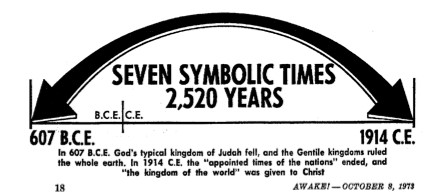

 It would be as if I had a very young son whom I told: “If you eat this Twinky you will die that very day.” But a neighbor-kid tells him truthfully: “You can’t die from eating a Twinky.” Then my son eats the Twinky, and I lock him outside where, after several days, he dies of exposure and starvation. Then I say: “See, I told you you’d die from eating that Twinky — within uh, a ‘day:’ as I interpret ‘days.’ Too bad for you, but the important point is that I am vindicated! I told the truth and that neighbor-kid was lying to you.”