
 Of all the odd things I did as a Witness, resuming praying seemed the oddest at the time.
  I had been taught to pray in my Catholic youth, but had given it up for Lent one year, and had never gotten back into the habit after “Easter.” These early prayers were mostly “vain repetitions” learned by rote.
I even prayed the rosary, where some beads signaled an “Our Father” and others a “Hail Mary” (not to be confused with the desperado pass in football.)
I recall that in praying the “Hail Mary” I never understood what “the fruit of thy womb, Jesus” meant. I didn’t know what a womb was. I thought we were saying “fruit of thy whom Jesus” which didn’t make much sense (but then neither did all the Latin we chanted back and forth with the priest during mass in the days before Vatican II changed the rules.)
 That prayer ended with another curiosity: we asked Mary to “pray for us sinners now, and at the hour of our death.” This generated a lot of questions in my young mind. If Mary was going to pray for us now, why would she have to pray for us again at the hour of our death? Hadn’t her first prayer done us any good? And how would Mary know when it was the “hour of our death”? That seemed to mean that there had to be a predestined time for us to die! I wondered if Mary kept a logbook of those who had prayed a “Hail Mary” sometime in their life and then when she saw that their time was running out within the next sixty minutes began praying for them again. Poor Mary would be kept woefully busy praying for a multitude of sinners simultaneously around the clock1. Not my idea of heavenly bliss!
I decided to give Mary a break and not ask her to pray for me anymore. I threw away my rosary, and the following year I gave up Catholicism for Lent.
When I became a Witness I enjoyed laughing at such foolish notions held by my former religion. But, did I come to find anything laughable in the Witness idea of prayer?
Witnessing Prayer Amongst the Witnesses
I found that prayer was a little different amongst the Witnesses. Their prayers always started out “Dear heavenly father Jehovah,” as if they were dictating a letter. It struck me as too informal. Even an Earthly judge is addressed as “your honor” rather than, “Dear Fred,” for instance. Then there’s the matter of respect. If I addressed my father by his first name it would be seen as disrespectful. But we thought Jehovah was so in love with the sound of his own name that he didn’t mind the disrespect, and rather appreciated our constant overuse of it [even if we were horribly mangling it due to the mistranslation of the name from YHWH.]
Although the Witnesses eschewed rote prayers, they nearly always followed a set formula:
- The salutation (“[Dear] heavenly father Jehovah.”)
- Thanks (with plenty of obsequiousness thrown in such as thanking God for the privilege of serving him.)
- Putting in an “order” for what was wanted (e.g. productive field service or an enlightening Watchtower study [not much chance of the latter order being filled!])
- More asking for what was wanted (typically including “an extra portion of your spirit.”)
- Remembering the “persecuted brothers,” missionaries, Bethel workers, etc.
- Looking forward to the “new order” (with more obsequious fawning at the prospect of serving Jehovah forever in paradise.)
Then would come the closing. This was critically important; without the proper closing we thought that God wouldn’t hear any of what went before in our prayer. Kind of like writing an email and forgetting to hit the Send button.[But this was a little odd because we were told that he had no trouble hearing any gossiping we might engage in even without such conversations having to end with the closing formula.]
The closing was always:
“We ask this all in Jesus’ name: ‘Amen’.”
I always wondered why they said that Jesus’ name was “Amen.” I knew that Jesus’ was nicknamed “the Word,” and the Watchtower told us he used the alias “Michael” when he went off battling serpents and such.  But I was always curious as to why he would adopt the name of that Egyptian deity Amen (aka Amon-Ra) [as Revelation 3:14 informs us that he did.] I also wondered why we thought it so important to always remind God of this fact at the close of every prayer. I speculated on what would happen if I were to close my prayer with “…in Jesus’ name: Michael.” Would that work just as well, or would it end up in the dead-letter office of undeliverable prayers?

Finally, the closing was followed by the only chanting the Witnesses indulge in: everyone would repeat Jesus’ alias: “Amen.” In the end the reason for this wasn’t any clearer to me than the Latin chanting of my Catholic youth.
 Witness tip: If you ever have to fake your way through a public prayer, the above formula can’t fail to win you accolades from your hearers for a job well done. [It worked for me many a time.]
 Another tip: The most memorable prayer I ever heard was performed by a Bethel brother in the dining room. Up to step 6 it was standard fare, but then he added the zinger:
“We look forward to the day when you will wipe out every two-legged germ from off the face of the Earth.”
 This not only evoked the obligatory chant of “Amen” at its conclusion, but was followed by gales of laughter by all in attendance [save yours truly.] So, in order to add spice to your prayer performance, don’t forget to take an occasional snipe at “worldly” people and their hilarious destruction.
Some Honest Questions about Prayer
 What does it mean to ask for “an extra portion of your spirit” from Jehovah? Is this the same spirit the WT tells us is an impersonal “life force”? So it’s roughly equivalent of “may the force be with you” from the Star Wars movies? Does a person receiving “an extra portion” of life-force thereby become “more alive”? [If so, what, exactly does “more alive” mean? I always thought you were either alive or dead, without any gradations between the two states of being.] Or do they thereby live longer, or what?
 I imagined that receiving “an extra portion” of Jehovah’s spirit would be similar to somehow plugging a 120-volt appliance into a 240-volt outlet and watching the meltdown that would ensue.

I remember in the Kingdom Hall when they came to this part of the prayer I would picture everyone’s hair suddenly standing on end as they began rolling their eyes, yelling in tongues and doing the jitterbug amidst crashing folding-chairs and sparks of electricity shooting from their fingers. [Everyone thought I was smiling after the prayer due to my contemplating Jehovah; little did they know.]
If God’s spirit is everywhere (the whole omnipresent thing) then how can it be divided up: a portion here and a portion there? If an “extra” portion goes somewhere is it removed from somewhere else? So are people dying left and right every time the Witnesses are energized in this manner — rendering their prayers murderous?!
Jesus made a great point in regards to prayer when he reputedly said “God already knows what you need better than you do.” (MT 6:8) Everyone seems to forget this when they pray. Jesus himself forgot it when he gave us the “model prayer:” (MT 6:9-13) asking for daily bread, forgiveness, and not to be led by God into temptation [which, according to the Bible God would never do anyway — (James 1:13) so why pray for God not to do it?]
Frankly, to me, prayer has always seemed the height of impertinence. We pretend to speak to the ultimate, all-mighty, all-knowing being with patronizing flattery and requests for things he should already know we need. Shall we “pray for peace”? Okay, but why wouldn’t God already know that we need peace? If peace were important to him he would’ve done something about it already, right? Shall we pray for the sick? Okay, but why would a God who created disease and watched as people got sick suddenly change his mind about their fate just because we asked him to? Does God assume we know better than he does? Do we imagine God saying, “Hmmm, I was going to let that stroke of Mrs. Olson’s prove fatal by Wednesday. But Bob Jacobs just prayed for her to get better. Bob’s plan sounds better than mine; guess I’ll change my mind and cancel that Wednesday death.”?
Worse is when people bargain with God in their prayers: “If you’ll make Linda say Yes to my offer of marriage I’ll never miss another meeting as long as I live.” As if God — with the entire universe to keep running — would take time out to consider your deal and then force someone into marriage [manipulating freewill in the process] just for the thrill of seeing your face every week in the Kingdom Hall!
Two biblical examples of such bargaining come to mind. One is of Jacob offering to take on Jehovah as his God: if he’ll feed and clothe him, then Jacob will make Jehovah his god and give him a tenth of his earnings (Gen 28:20-22). [Can’t you just picture God herding every 10th sheep of Jacob’s into heaven?]
The other example is that “great man of faith” Jephthah who promised to burn to death the first person he saw coming out of his house if Jehovah would help him murder the children of Ammon (Judges 11:30-31). According to the Bible, both bargains were accepted and successfully completed [in Jephthah’s case with the burning of his daughter! (Judges 11:33-40) Making him one of our top 5 most-wanted.]
In the Bible Jesus reputedly said that whatever we ask for will be granted. (Mt. 21:22) So what happens when people pray for opposite results? What if, while Bob was praying for Mrs. Olson’s recovery, Mr. Olson was praying for a quick and painless release from his wife’s suffering? (We’re assuming, of course, that both Bob and Mr. Olson are devout Jehovah’s Witnesses in good standing, putting in over 10 hours of field service each month, never visiting apostate sites, and following the standard prayer-formula given above.) There’s no possible way to grant both opposing prayers, so what Jesus reputedly claimed is false.
An Experiment in Prayer
But let’s be scientific about this and turn from the hypothetical to the experiential: let’s conduct our own little experiment. It should be very easy to validate the truthfulness of Jesus’ statement. If God grants everything we ask in prayer, then let us pray:
“God, please send me ten million dollars in the mail today. In Jesus’ name: ‘Amen’.”
 Wait a moment… my mail carrier is walking up to my mailbox right now… he’s delivering something! Let me see… Damn; it’s just the latest Watchtower and some other junk mail. My prayer wasn’t answered. Was yours? If not, then we are forced to conclude that what Jesus reputedly said about prayer is evidently not true. [On the other hand, if you did receive your ten million dollars I’ll recant this whole article if you’ll send me a ten percent “finder’s fee” for having given you the whole pray-for-10-million-bucks idea.]
Controlled experiments have been conducted on the effectiveness of prayer. Some of these have shown a slight advantage to those prayed for over the non-prayed-for control group. Some believers have been quick to jump on these results as proof of the effectiveness of prayer. Let’s see why they’re wrong.
If prayer has no effect, then the results of such experiments will be random: sometimes one group will fare better, and sometimes the other group will fare better (like flipping a coin). This seems to be the case: one article states that only in 57% of known studies did the prayer-group fare better http://health.howstuffworks.com/prayer-healing1.htm (esp. second page). That’s hardly impressive (if I flip a coin a hundred times, I wouldn’t be amazed if it came up heads 57 times.).
An experiment that proves something needs to produce those results every time it is performed (“repeatability”). Also, by “randomizing” and then not afterwards categorizing the healthier patients on both sides, the experiments fail to take into account the non-random factors of age, original severity, genetic makeup, healthier diets and exercise, environmental factors, other health issues, etc… (For instance, maybe the randomization resulted in one group being on average younger or stronger than the other, and that just happened to be the group prayed for.) http://www.religioustolerance.org/medical4.htm
Believers are also failing to take into account the fact that many experiments failed to show any meaningful difference between those prayed for and those not prayed for. For instance:
http://www.washingtonpost.com/wp-dyn/content/article/2005/07/14/AR2005071401695.html
So, the meta-analysis (combining the results of several studies) has shown that prayer has no meaningful effectiveness beyond the placebo effect.
Finally, a personal, opinion of mine: If you think prayer is somehow answered by a conscious being (“god”) then it seems unfair if this god somehow provides more help to people who are prayed for than to those who are not prayed for. So, here’s a little boy with leukemia in the control group, and another in the prayer group. This omniscient, omnibenevolent god looks at these two boys with the same affliction and decides to work divine magic on the one prayed over, but lets the other one suffer on his own. I guess hospitals are more ethical than this god; they try their best to help both boys.
So, I don’t see the point of prayer. If god knows what to do, has the power to do it, and is so loving that he will always do the compassionate thing, then how could prayer influence him? It could not; he would already do the right thing without being asked.
It’s very simple: “Coulda, shoulda, woulda” — If he could’ve helped and should’ve helped, then he would’ve helped (without having to be asked). If we came across someone bleeding in the road we would help that person without someone having to ask us. But we are to believe that god is not as ethical as us? He needs to be asked before it dawns on him to help? Nonsense! It just makes the conclusion inescapable: when little boys suffer and die from leukemia there can be no all-powerful all-good all-seeing god.
So, when it comes to prayer you can stop wasting your breath and your time; no one capable of answering is listening. If you want something it is up to you to get up off your knees (or off the podium) and work for it yourself.
And mealtime prayers to “bless” the food — especially in restaurants: don’t get me started on that!
FOOTNOTE:
1 Worldwide, about 6,098 people die each hour. The ratio of Catholics in the world population is 17.5%. That means that about 1,067 Catholics die each hour. Probably at least 90% of them prayed a Hail Mary at some point in their lives. That means there are 960 people for Mary to pray for each and every hour. That’s 16 per minute, which gives her less than 4 seconds per person. Maybe that’s just enough time to rattle off “Forgive Catherine Elizabeth Bernadette O’Sullivan” before moving on to the next name. With such a demanding schedule, I don’t know how she ever finds time to also “pray for us now,” and still put in so many guest appearances on Earth.
return
 Andrew posted a great article over a year ago entitled Evolution for Jehovah’s Witnesses. In that article he did a good job of answering the common objections Witnesses have been taught from the Watchtower regarding evolution.
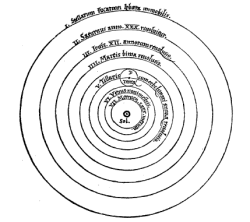 The notion that the Sun orbits the Earth is simple, clear, and intuitive. It was what nearly everyone regarded as obvious common-sense for the vast majority of human history. It was also completely wrong. When Copernicus suggested the opposite theory: that the Earth orbited the Sun, his work was condemned as both unscriptural and unscientific by the religious leaders of his day.
 Newton’s laws of physics
 are also, for the most part, simpler and more intuitive than Einstein’s theory of relativity. Yet it is the latter that more accurately explains how the universe operates (especially at a grander scale than our day-to-day lives usually entail.)
 Okay, first of all you have to establish the year 1914 by taking the “seven times” of Dan. 2 and multiplying by 360 [according to a totally unrelated biblical formula of “a day for a year” — and pretending that a year consists of 360 days instead of 365.] that gives you 2,520 years for the “Gentile Times” — even though in that account in Daniel King Nebuchadnezzar, representing the Gentile power of that time, was off his throne for those “seven times,” lost to madness and grazing like a cow in the field — we’ll still pretend that the seven times represents the time when gentile kingdoms will rule the Earth before “spritual Israel” takes over.
 As to being difficult to understand, this is something each individual will have to answer. But I would say that if you can understand the Watchtower’s dogmas (such as the typical reasoning displayed above) then you should have no trouble understanding the relatively simple notion of variation + natural selection over time (which evolution consists of).
 These days, Witnesses are quick to point out that they are eight million people strong. We’ve seen it in several comments they’ve posted. The implication being that eight million people can’t be wrong. It’s the same argument Elvis fans have used for years.
 “many are called but few are chosen” and all the other arguments they can come up with to prove the opposite point: that the true religion will have few adherents. Blowing raspberries is an appropriate response to this.
 Many years ago I wrote an article entitled “
 But the grand booby-prize, as usual, must go to our old friends: the governing body of Jehovah’s Witnesses. Recently, at their international conventions, governing body members read out the statement that there is more evidence for their god’s kingdom having started ruling in the year 1914 than there is evidence for gravity, electricity, and wind.